
Jacob Solis Cohen: (1838-1927) America’s First Head and Neck Surgeon
Jacob Solis Cohen was born in 1838, coinciding with the year Horace Green began his practice focused on throat diseases, establishing himself as the first specialist in airway surgery. Similar to Green, Solis Cohen possessed ancestral ties to the American Revolution; his great-grandfather is documented as having served alongside Washington’s forces during the French and Indian War and later supplied provisions to the Continental Army during the Revolutionary War. Solis Cohen’s family was a Jewish immigrant family from Europe who arrived in America in the 18th and early 19th centuries. They demonstrated a strong sense of patriotism and dedication to public service in the United States.
Solis Cohen’s reflection on his childhood was explained at the annual dinner of the 40th anniversary of the ALA. “Like every other boy, I became thrilled with the glamour of the exploits of Washington, of Putnam, of Anthony Wayne, and of all the other Revolutionary heroes, and wished that I had lived in those stirring times to have participated in them.”
Solis Cohen was raised in Philadelphia, earned his medical degree from Jefferson Medical College in 1857, and completed his surgical training at the University of Pennsylvania in 1860. Motivated by his sense of honor and service, and Lincoln’s call to arms to save the Union, he volunteered as a surgeon in the Union military. After completing two years of service in the Army, he subsequently volunteered for an additional two-year term in the Union Navy. Solis Cohen’s four-year postgraduate education was distinctive. It was a de facto post-residency surgical fellowship that provided comprehensive training in General Surgery, managing critically ill soldiers from the carnage of the Civil War. In later years, he referred to the War of Secession as the ‘Uncivil War’, which reflected his upbringing, his compassion as a physician, and the philosophical recognition of the carnage of war.
Possibly the only universal value of human armed conflict and war is that it typically enhances surgeons’ skillful craft, benefiting humanity and societies for decades thereafter. To the best of my knowledge, Solis Cohen was the first formally trained surgeon to specialize in laryngology and head and neck surgery, a model for our training to this day. His approach to treating upper aerodigestive tract disease was unprecedented and foundational to his extraordinary accomplishments over the next 60 years. Throughout his career, he maintained that a laryngologist should be equally skilled in endolaryngeal and transcervical surgical techniques.
After concluding his service in the Union military, Solis Cohen communicated with Louis Elsberg, his classmate at Jefferson Medical College. Unlike his American contemporaries in laryngology who received European training, Solis Cohen taught himself the art of mirror laryngoscopy.
His dental colleagues in Philadelphia provided access to their mirrors, enabling him to examine patients’ larynges as they recovered from nitrous oxide anesthesia after oral cavity procedures. Given his extensive battlefield experience over the preceding four years, it is understandable that Solis Cohen did not consider mirror laryngoscopy to be particularly challenging.
Solis Cohen began his career as a surgeon specializing in the upper aerodigestive tract and provided leadership and guidance to this emerging field for many years. In 1869, he is credited with being the first to successfully treat laryngeal cancer. This surgery was carried out on the son of a professor at the University of Pennsylvania. In that procedure, Solis Cohen performed a tracheotomy, transcervical laryngofissure, and partial laryngectomy. Elsberg traveled from New York to assist him. The patient decannulated himself and lived cancer-free for 20 years.
The operation was performed under minimal lighting and was closely observed by a distinguished group of senior surgeons, including Samuel Gross and Joseph Pancoast, both of whom opposed surgical specialization. Drawing on his Civil War experience, Solis Cohen maintained his composure and was prepared for this pivotal moment in the history of laryngology.
His graphic description of the procedure with limited hemostasis while the patient was continuously coughing is illustrated by the chilling quote, “…on account of the spasmodic action of the larynx, the tumor tore loose from the forceps again and again, and spattered the blood into the faces of all about the patient, filming my spectacles so that I could not use them, and frescoing the ceiling with blood-spots over a large surface.”
Another important achievement of Solis Cohen was to perform and perfect total laryngectomy in America by suturing the proximal trachea to the neck skin and separating the airway from the digestive tract.
Because of his pharyngeal closure method, Solis Cohen subsequently described alaryngeal pharyngo-esophageal phonation, which is swallowing air and subsequently burping, not unlike a feeding infant. Although Gluck in Europe likely sutured the trachea to the skin of the neck, previously creating a tracheostoma. Solis Cohen was probably unaware of that work, and it is not disputed that he perfected total laryngectomy in the United States.
In the early 20th century, devices were designed to divert air from the trachea to the mouth, which facilitated limited speech.
Elsberg’s and Solis Cohen’s enduring friendship and collaboration were the most critical forces in establishing laryngology and laryngeal surgery in the USA. Shortly after Elsberg published significant academic contributions to laryngology and endolaryngeal surgical approaches, Solis Cohen expanded on this work by reporting on transoral and transcervical procedures, drawing on his surgical training and experience.
They both published extensively and lectured to general medical/surgical audiences as well as like-minded laryngologists. In 1872, several years after becoming an established head and neck surgeon, Solis Cohen authored the most comprehensive textbook of Laryngology and Laryngeal Surgery in the 19th century. He served as a mentor to Chevalier Jackson, also from Philadelphia, who is widely regarded as one of the most distinguished laryngeal surgeons in history.
Jackson graduated from the Western University of Pennsylvania (now the University of Pittsburgh) at age 17 and from Jefferson Medical College at age 21. Jackson attended clinics taught by Solis Cohen, who influenced him to pursue a career in laryngology. In 1886, Solis Cohen provided young Jackson with his 1872 textbook and Morrell Mackenzie’s writings. Decades later, in 1915, Jackson modeled his comprehensive textbook, “Peroral Endoscopy and Laryngeal Surgery,” after Solis Cohen’s 1872 book.
Elsberg and Solis Cohen retained their commitment to general medical education. This is evidenced by Elsberg’s address to Dartmouth Medical College in 1883, Solis Cohen’s invitation for Elsberg to address the Jefferson Medical College, and Solis Cohen’s presidential address to the Philadelphia County Medical Society. They worked closely together to create and edit the Archives of Laryngology until Elsberg’s illness and death in 1885.
Another key aspect of the kinship between Elsberg and Solis Cohen was that both were Jewish, and their families had immigrated from Europe to America to escape persecution and build a better life. This cultural bond, along with their families’ philosophy of education, service, and religion, created a unique academic medical partnership at a critical moment in the development of Laryngology in America.
The Solis Cohen family and Jacob’s life, from his childhood through his death at the age of 89, are remarkably well documented. These papers, communications, and documents are in the archives of multiple museums, medical institutions, and universities. A particularly compelling example of Jacob’s spirit, available in the Jefferson Medical School Archives, illustrates his persona. Young Jacob’s school essays were preserved by his parents, providing valuable insight into his demeanor during his career as an elite physician and surgeon. In one of the essays, 12-year-old Jacob expressed grave concern that excessive funds were being spent on July 4th fireworks when poor people were starving in the streets of Philadelphia.
As a Civil War veteran, Solis Cohen attended the dinner wearing his insignia and medals. His deep commitment to his family’s heritage, human rights, patriotism, and Jewish religion is evident in his remarks. He reminded the audience of the remarkable history of Washington and the Revolutionary War, Lincoln and the Civil War, and he paid tribute to World War I veterans in attendance.
Solis Cohen was deeply troubled by slavery and expressed this in a metaphor comparing Moses’ leadership of the enslaved Jewish people and Lincoln’s leadership to abolish slavery in America. ”Like Moses of old, who from their land of bondage led the Israelites to their land of promise, Father Abraham was permitted a limited view of his completed mission and was debarred by death from taking part in its further development, and like the Biblical prophet in Exodus, the secular prophet (referring to Lincoln) of the recession became destined to live throughout the ages of man spiritually enshrined in the hearts of his people and his people’s posterity.”
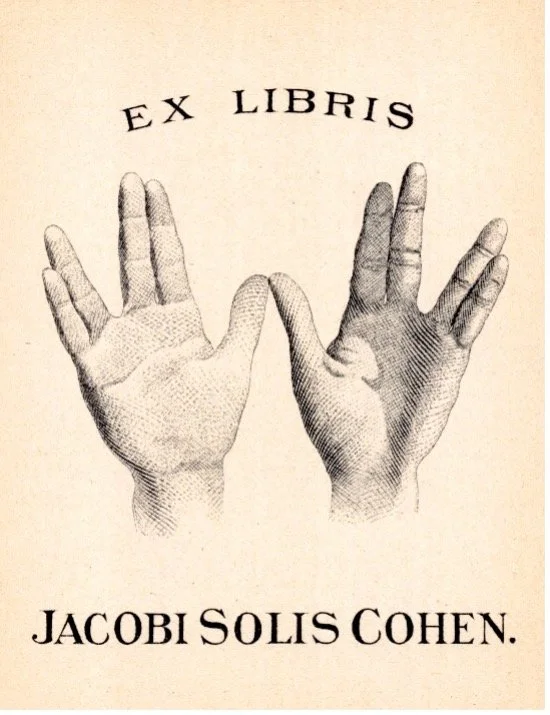
A notable indication of Solis Cohen’s profound connection to his family heritage and Jewish cultural roots is his distinctive 19th-century bookplate, recognized by bibliophiles. The bookplate displays the hand gesture associated with the Cohanim, representing the priestly lineage that traces its origins to Aaron, brother of Moses.
Today, the Vulcan hand salute is widely recognized due to its association with Spock from Star Trek. Leonard Nimoy, who portrayed Spock, proposed this gesture to the directors of the 1960s television series, drawing inspiration from his childhood observations of the practice in his Jewish synagogue.
I was fortunate to meet Solis Cohen’s granddaughter in the 1990s, when I delivered a lecture on Jacob to the Solis Cohen Medical Society in Philadelphia. We discussed her grandfather, whom she remembered as a young child. She showed me his Bible, which he carried throughout the Civil War, and his patient diary from the late 1860s, when he began his career as a Laryngologist and laryngeal surgeon. By 1872, he published the first comprehensive textbook in the United States. She kindly gave me a few of his unused bookplates.
Significant recognition was accorded to Solis Cohen for his notable seventy-year career as an innovative surgeon in an emerging nascent medical and surgical specialty. His contributions were especially impactful during several of the most demanding eras in United States history, such as the Civil War and World War I. He was a visionary pioneer, educator, role model, and guiding light to his contemporaries. Despite his passing almost a century ago, Jacob Solis Cohen remains a luminary for those aspiring to perfect the art and craft of caring for patients with laryngeal and voice disorders.
Excerpt from Voice Journeys: A Surgeon’s Story.