
Horace Green: (1802-1866) The Father of American Laryngology and Tracheo-Bronchology and Airway Surgery
Horace Green was the first specialized airway physician in the United States and endures as one of the greatest pioneers in American medical history. His life’s work was committed to diseases of the pharynx, larynx, and trachea. He dedicated his career to the study and treatment of diseases affecting the pharynx, larynx, and trachea. Over the following century, Jacob Solis Cohen and Chevalier Jackson continued to advance the field established by Green.
Among Green’s monumental seminal contributions are that he was the first individual; 1. To directly treat diseased mucosa of the tracheobronchial tree, 2. To perform direct laryngoscopy, and 3. To endoscopically remove a laryngeal lesion with direct visual control.
Horace Green was born in Chittenden, Vermont, on December 24, 1802. His grandfather was a Massachusetts physician who had four sons who fought in the American Revolution. He graduated from Castleton Medical College in 1824 and subsequently attended lectures at the University of Pennsylvania. After practicing for a few years in Vermont, Green moved to New York City in 1835, where he practiced most of his career. In 1838, he traveled to Europe in 1838 to advance his studies and investigations into throat diseases.
Infectious Airway Obstruction in the Early 19th Century
Descriptions of infectious diseases of the airway date back thousands of years. There have been a wide variety of names, including phthisis, cynanche laryngeal, quinsy, laryngeal and pharyngeal angina, diphtheria, tuberculosis, consumption, and croup. From ancient civilizations through the 19th century, tracheotomy, a primary treatment, was seldom done. This was because there was limited understanding of human airway anatomy and physiology, the biology of these diseases, and skepticism about the efficacy and safety of a tracheotomy. In the early 1800s, there was a substantial expansion of investigations and reporting on these infectious airway diseases. There was even a report of nasotracheal catheterization.
Green was highly focused on transoral instrumentation, with topical caustic application to diseased laryngotracheal mucosa. I reviewed the early history of orotracheal intubation and tracheotomy in 2008. After Green, Solis Cohen, who was probably the first formally trained head and neck surgeon and a specialist in laryngology, contributed greatly to the principles of airway stabilization.
During Green’s era, there was significant demand for novel transoral management of infectious airway diseases due to potentially lethal consequences of these disorders, as well as the procedure of tracheotomy. The apprehensive reservations expressed by both patients and clinicians reflect the gravity of the situation and the complexities of inconsistent treatment outcomes.
Despite the expanding acceptance and performance of tracheotomy in the 19th century, the procedure continued to be appropriately perceived by most clinicians as a heroic intervention to be done in dire circumstances, often when the patient was near death from airway obstruction. This was especially so for those attempting tracheotomy in children.
Despite a range of systemic pharmacological treatment strategies that successfully managed most infectious airway diseases in the 20th century, aggressive recurrent respiratory papillomatosis (RRP) remains a 21st-century challenge. Systemic control is currently in its early stages of development from both scientific and economic perspectives.
Green’s Controversial Transoral Treatment Methods
Green well understood the ravages of the diseases that he committed his career to treating. His novel approaches to the airway evolved from two clinical imperatives: infectious airway diseases were lethal, and tracheotomy was problematic. The high-intensity controversy between transoral and transcervical interventions for airway obstruction described herein would recur in a similar manner with Joseph O’Dwyer 40 years later and remains today in selected clinical scenarios.
In 1840, Green introduced his method for the transoral blind application of therapeutic caustic agents, such as silver nitrate, to the laryngeal mucosa at the New York Medical and Surgical Society. He later described in detail that, due to the initial skepticism with which his technique was received, he refrained from presenting his findings to medical organizations for several years. Visualized mirror-guided applications were not implemented until nearly two decades later, which was subsequent to Garcia’s presentation of indirect laryngoscopy.
Green systematically advanced the transoral endolaryngeal administration of topical mucosal therapies for infectious membranous airway diseases affecting the larynx and pharynx, subsequently extending these techniques to the tracheobronchial tree. He developed standardized procedures for blind cannulation between the vocal cords, enabling access to the trachea, bronchi, and lungs. His methodology relied on systematic patient training and sensory adaptation to the instrumentation of the supraglottic and glottic regions to avoid the gag reflex. This approach was identical to the methods employed during the first 25 years of mirror laryngoscopy, prior to the introduction of topical cocaine anesthesia.
Two of Green’s primary instruments were a whalebone probang with a cotton sponge at the tip for direct administration of caustics and a hollow-lumen, curved catheter for injecting caustics into the airway. The sponge-probang was used to apply the caustic directly and to mechanically remove debris and exudate. The catheter was used to inject compounds directly into the airway, which were then diffused by expectoration.
Green’s instruments for laryngotracheal topical treatment: a whalebone probang with a distal sponge and a syringe-cannula for instillation of topical fluid caustics to treat the diseased tracheobronchial membranes.
The reaction to Green’s diligent efforts is likely the most striking example of malicious reactions to a key innovation in laryngological history. The resulting controversy was so dramatic that the New York Academy of Medicine established a committee to review Green’s academic reports in response to skepticism expressed by some of his peers.
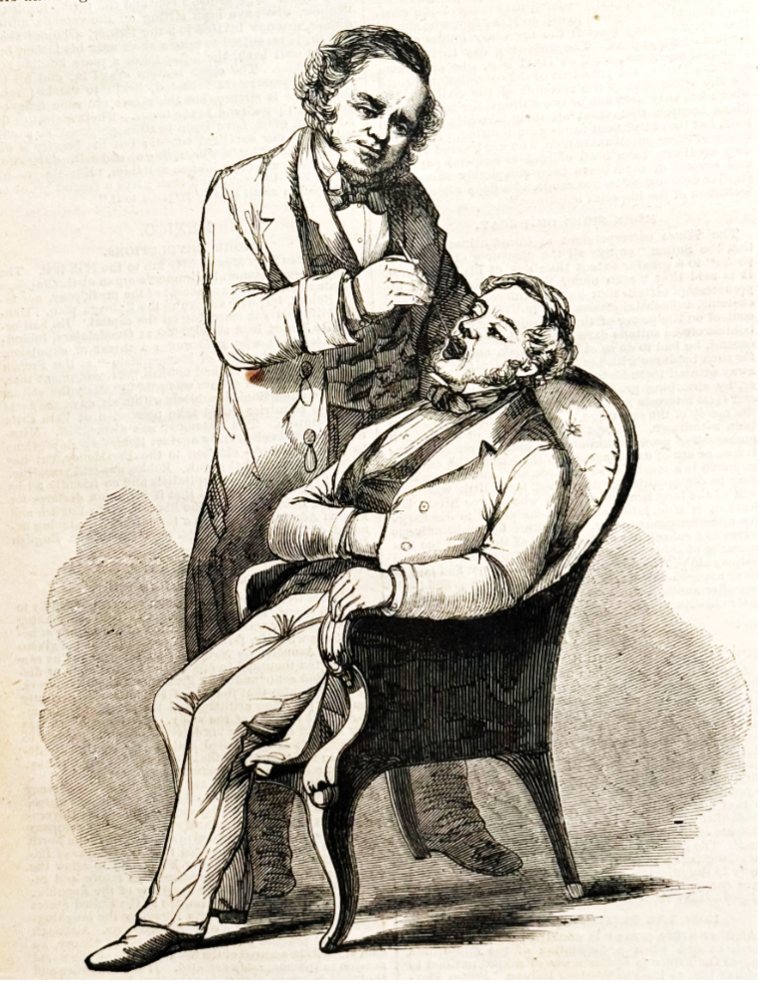
A detailed account of the incident appeared in the mainstream publication Harper’s Weekly in 1859. After systematically perfecting his technique and presenting his findings, Green was subjected to vicious criticism from several peers who questioned his abilities and integrity, prompting him to respond publicly. A complicated, fierce academic battle ensued, which is well beyond the scope of this work. However, Green silenced his critics by successfully demonstrating the technique in patients in whom the cannula was visible through a previously performed tracheostomy for airway obstruction.
Green demonstrated notable courage and was subsequently exonerated by the professional community in a public forum. His experience illustrated how selected jealous colleagues can respond to an innovator’s disruptive, unique skill sets when performing a difficult technical task.
In fact, blind awake laryngeal intubation would be considered an extremely difficult maneuver today, even with the advantages of topical anesthesia. When I started my residency in head and neck surgery, the chief of anesthesia at the Boston VA Medical Center, Dr. Donald Mahler, described performing the procedure under extreme circumstances where a laryngoscope was unavailable in the battlefields of Korea. To save the soldier’s life, he was required to employ one hand as a laryngoscope speculum while using the other to position the tube through the vocal cords and into the trachea by feeling soft-tissue resistance and listening to respiratory sounds.
Equally remarkable to Green’s airway accomplishments was that he also performed the first direct laryngoscopy and the first visually controlled endoscopic excision of a laryngeal neoplasm in history. The procedure was performed in 1844 on a 10-year-old female patient with airway obstruction due to a ball-valve polyp. Green initially had her tonsils removed since she had intermittent cyanosis (turning blue from diminished oxygen) and obstructive sleep apnea. This may be the earliest report of tonsil removal for obstructive sleep apnea in a child and remains an indication for tonsillectomy today.
The child continued to have airway-obstructing throat symptoms while sleeping, so Green reexamined the child. He used a bent-tongue spatula, comparable to a modern intubating laryngoscope, to examine the throat further, using sunlight over his shoulder for illumination. He then observed a ball-valving fibroepithelial polyp on a pedicle that obstructed the laryngeal introitus on inspiration.
Green grasped the mass with a curved double hook forceps, avulsed the benign tumor, and the airway obstructive symptoms resolved. He had performed the first direct laryngoscopy and visually-controlled removal of a laryngeal lesion. His success was achieved because a child’s larynx is positioned higher in the pharyngeal cavity. Direct laryngoscopic examination of the larynx was not achieved again for more than four decades. In 1895, Kirstein employed topical cocaine anesthesia and electric illumination, rather than sunlight, for endolaryngeal visualization, thereby initiating the era of direct laryngoscopy, which continues today.
Over the past 175 years, both indirect and direct approaches to endolaryngeal surgery have provided definitive evidence of Green’s exceptional expertise, corroborated his assertions, and recognized his contributions as among the most significant in the history of human airway management. Green passed away in 1866, having received widespread recognition for his contributions during the final years of his life following the emergence of laryngology in 1857.
Excerpt from Voice Journeys: A Surgeon’s Story.