
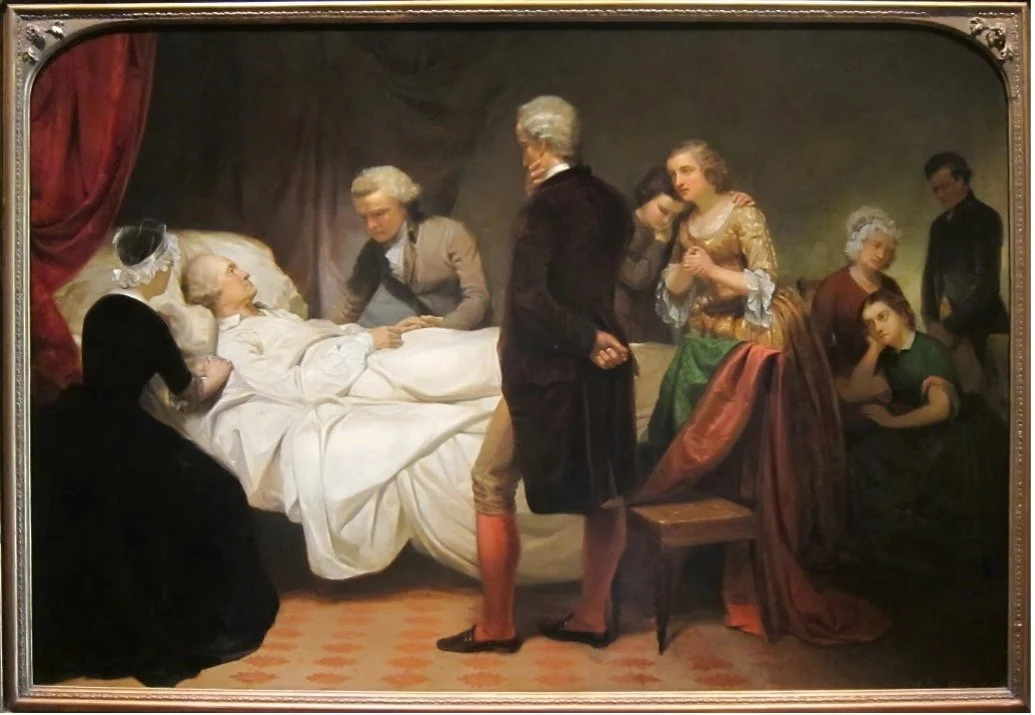
George Washington: (1732-1799) Death from a Throat Infection that led to Laryngeal Airway Obstruction
George Washington, distinguished general and one of the founding fathers of the United States, passed away on December 13, 1799, due to a throat infection and laryngeal airway obstruction. His illness followed exposure to adverse weather conditions, including rain, hail, and snow. While riding throughout Mount Vernon the previous day, Washington began exhibiting symptoms consistent with a cold. His initial symptoms included a sore throat and hoarseness.
At 2 AM on the 14th of December, he developed chills, dyspnea (shortness of breath), and odynophagia (painful swallowing). Following the administration of localized treatments, including bloodletting, emetics, and inhalation of vinegar vapors, Washington’s condition deteriorated rapidly, resulting in death at approximately 10 PM that evening.
Due to the limitations of medical knowledge during that era, an exact diagnosis of Washington’s inflammatory infectious condition affecting his larynx and pharynx was not possible. The resulting airway obstruction was diagnosed as cynanche laryngea trachealis. Historical records indicate that Washington’s condition included significant inflammation accompanied by a discharge of blood and purulent infected drainage or exudation (pus), commonly referred to then as croup.
During that period, there was significant concern regarding airway obstruction resulting from infectious diseases, which could ultimately lead to mortality. Washington’s death served as a notable example that impacted American medical practice and culture in the nineteenth century. Laryngeal airway obstruction gained further prominence with the advent of mirror laryngoscopy, which enabled routine visual examination of the larynx.
Excerpt from Voice Journeys: A Surgeon’s Story.