
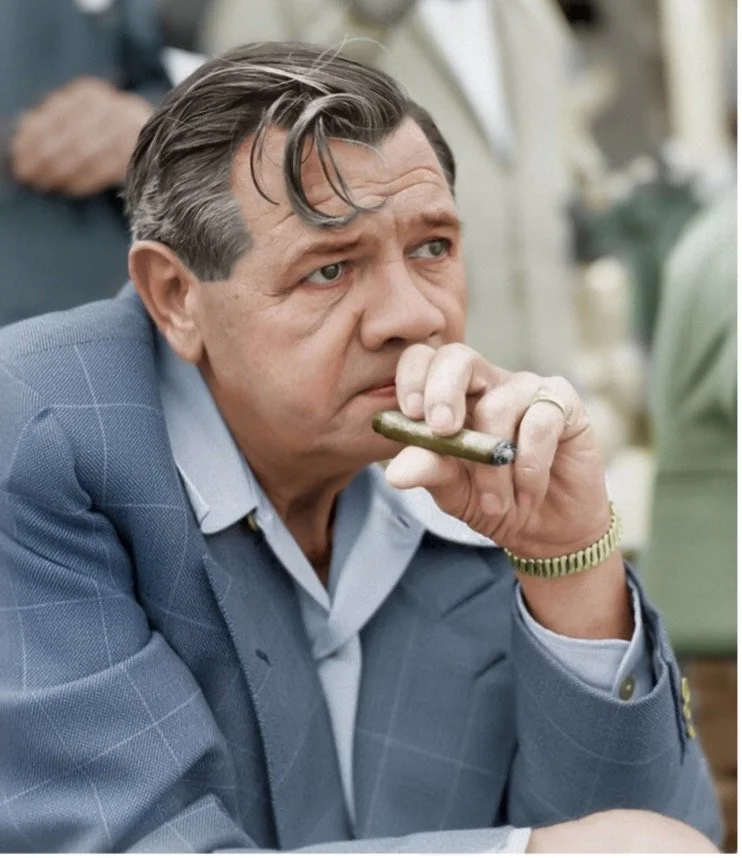
Babe Ruth in 1947 at age 52, soon before he died from throat (larynx and pharynx) cancer
Babe Ruth: (1895-1948) Death from Pharynx and Larynx Cancer
Babe Ruth is one of the most recognized athletes in American history. His accomplishments on the baseball diamond, both as a hitter and pitcher, are legendary. He likely remains the best-known baseball player today, owing to his achievements a century ago.
A less commonly known aspect of Ruth’s life was his battle with throat cancer, caused by smoking, which ultimately caused his death at age 53. His experience highlights the severe impact of persistent throat cancer, which has had a lasting impact on American society.
In his day, Ruth was a physically towering figure (6 feet 2 inches, 215 pounds), and he was a larger-than-life persona in the country’s consciousness. This was amplified by his creation of the power-hitter archetype during the Roaring 20s’ excess and indulgence. Ruth impacted baseball in the same way Jack Dempsey, the renowned heavyweight boxer, did.
In 1945, Ruth lost about 40 pounds without intentional dieting. This was likely the sentinel event signaling the presence of his throat cancer, which was diagnosed the following year. Ultimately, he developed difficulty swallowing (dysphagia), pain, and hoarseness secondary to vocal cord paralysis. The disease had metastasized (spread) to the lymph nodes in his neck, which was an ominous sign, heralding the lethality of his malignancy.
As Ruth’s disease progressed, he experienced escalating pain, ongoing weight loss, and increasing frailty. He underwent several minor surgical interventions. As was common in medical practice at that time, Ruth himself was not told about his throat cancer diagnosis; however, according to reports, his wife was informed. It is likely that he ultimately realized that he had cancer when he was admitted to Memorial Sloan Kettering Hospital, a renowned cancer institution.
In June 1947, Ruth received chemotherapy as a last treatment option for his illness. He may have been the first patient with throat cancer to undergo treatment with a pharmaceutical agent. It was an analog of methotrexate, a chemotherapeutic agent that is still used selectively in current medical practice. Although the chemotherapeutic agent did shrink the tumor temporarily, the response was self-limited. The progression of the disease then accelerated, resulting in his death on August 16, 1948, less than one year later.
During Ruth’s final public appearances, the once physically imposing man was gaunt. To maintain his stability, he required a bat as a cane. His voice was weak, rough (perturbated), with difficulty projecting and generating loudness. Owing to paralysis of one vocal cord resulting from the tumor, he was unable to achieve proper closure with the contralateral, still-mobile vocal cord.
Excerpt from Voice Journeys: A Surgeon’s Story.